Pressurised Flow
If a closed reach runs full of water (flow depth equal to reach height), then a basic assumption for the derivation of the Saint-Venant equations is not valid since the flow changes from the free surface flow to the pressurised flow.
However, it is possible to generalise the equations for free surface flow, so that the pressurised flow in closed reaches is covered. This is done by introducing a fictitious slot in the top of the reach, see the circular reach with a fictitious top slot, usually referred to as a Preissmann slot.
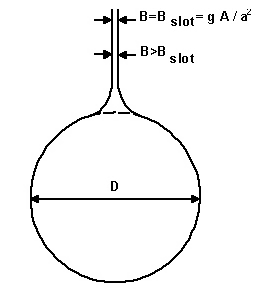
Figure: Circular reach with a fictitious top slot, usually referred to as a Preissmann slot.
The theoretical background can be found in Appendix A.1.1.
Smooth transition to top slot
In order to obtain a smooth transition between the free surface flow computations and pressurised flow computations, it is necessary to apply a “soft” transition between the actual reach geometry and the fictitious slot. Such a “smooth” transition has been designed based on a series of tests with various slot configurations. The slot configuration thus obtained ensures stable computations without affecting the accuracy significantly. Note that the applied slot width in general is larger than the theoretical value.
Pressure reaches
MIKE+ setups can have parts of a network defined as pressure reaches. A pressure reach can connect to other pressure reaches upstream or downstream. If a pressure reach does not connect to another pressure reach it must connect normal reaches through a downstream pump and a pressure reach tail node upstream. A pressure reach section of the network can only contain one pressure reach tail node. Nodes internal to a pressure reach section of the network are assumed to be sealed.
Pressure reaches are always pressurised, meaning that the water level is in the top slot of the cross sections in the reach.
The equations governing flow through a pressure reach are slightly modified to ensure stability of flow through the reach. The time derivative terms in the q-grid points is suppressed. In addition, a weir function is approximated on the h-grid points that connect to the pressure reach tail node.n