Urban links
Urban links refer to the type of coupling link that connects a manhole, inlet, basin, soakaway, or storage unit (SWMM model) with a surface model.
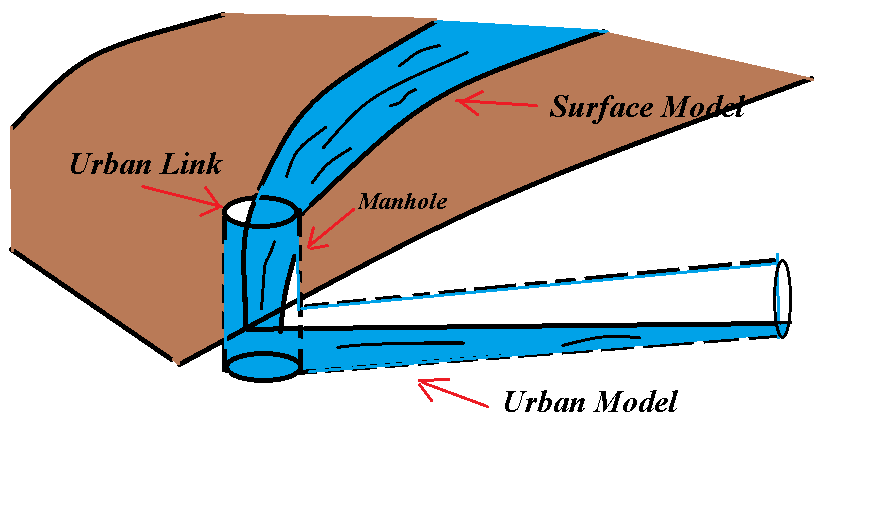
Figure: Illustration of a representative urban link (manhole).
The exchange of water (\(Q_{US}\)) at the inlet of either one of these options can be computed in three different ways:
- Orifice equation
- Weir equation
- Exponential function
- Curb Inlet function
The orifice equation is given by:
Equation: Orifice equation for the exchange of water at an urban link.
Where:
- \(Q_{US}\) — flow from sewer to surface grid point.
- \(H_{U}\) — water level in sewer system.
- \(H_{S}\) — average water level on the ground (among the link faces).
- \(A_{m}\) — cross-sectional area of manhole.
- \(A_{i}\) — cross-sectional area of inlet (not used for basins).
- \(C_{D}\) — discharge coefficient (typically 1).
Note
If the node's ground level is greater than either the water level in the node or the water level in the surface then the corresponding water level is overridden by the ground level.
The weir equation depends on whether there is flooding of the surface or not. If the surface is not flooded at the time, then it is calculated as a free-flowing weir:
Equation: Free-flowing weir equation for an urban link on a surface that is not flooded.
where \(W_{crest}\) is the crest width. The same equation is used if the surface is flooded but the water level in the node is below the node's ground level.
If the surface is flooded and the water level in both the surface and the urban model are above the node's ground level, then the weir is calculated as a submerged weir:
Equation: Submerged weir equation for an urban link on a flooded surface.
where \(H_{g}\) is the ground level at the coupling link location.
The exponential formula for computing the flow between the urban and the surface model is given by:
Equation: Exponential formula for the flow between the urban model and the surface model.
where \(S\) is the scaling factor and Exp the exponent.
Fixed unit system
In the exponential formula, the values of \(H\) are given in meters and the discharge is given in m3/s. If the discharge is needed in another unit system, first obtain it using m and m3/s and then convert, as the exponential formula does not have any meaning using another set of units.
For the curb inlet function, the flow between the manhole and the surface is transferred at a grate or inlet from a surface overland flow network to the sub-surface pipe network. The transfer capacity of the connection is specified as a tabular depth-to-flow (DQ) relation. When the water level of the manhole reaches the ground surface minus a freeboard parameter value, the DQ table is no longer considered and outflow from the manhole is simulated using the orifice equation instead.
For situations where the water levels in the sewer system and the surface model are very close to each other oscillations may occur and for that, a suppression factor can be used to dampen such oscillations. The suppression factor can be applied individually at each urban coupling:
Equation: Suppression factor damping oscillations between the sewer and surface water levels.
Where:
- \(Qdh\) — the threshold for the difference in water levels, \(dh\).
The suppression factor is only applied if the above inequality holds. The threshold is user specified and if set to 0.0 no suppression is applied.