Top Slot
When the water level exceeds the maximum water level in the processed data table, behaviour is defined by the top slot. There are several different types of top slots:
- No slot; the simulation will terminate if water level rices above the top level of the cross section.
- Vertical wall; assuming the river banks extend vertically upwards, see the vertical wall top slot above maximum specified height. Thus, the width remains constant for increasing water levels.
- Angle wall; assuming the river banks extend upwards at a specified angle. For positive angle, straight sides extend upwards, slanting out from the centre of the cross section. Thus, the width increases for increasing water levels. For negative angles, the cross section sides slant inward and the cross section becomes narrower for increasing water levels.
- Constant ARW; area, hydraulic radius and width are considered constant all the way up through the slot, having the value of the top of the cross section.
The vertical wall and angle wall top slots are intended for open cross sections. Their primary use is to prevent simulations from terminating should any initial instabilities occur. They should not be used to accommodate a lack of knowledge concerning the cross section geometry, see the vertical wall top slot above maximum specified height. The simulation is terminated if the water level becomes more than N times higher than the height of the cross section, where N by default is 4.
The default value for N can be changed in the ini file for MIKE 11, ‘MIKE11.ini’, see D.2.
The angle for the angle wall top slot can be changed in the MIKE+ (Collection System) ini file, ‘dhiapp.ini’.
The constant ARW top slot is intended for closed cross sections and is vital when pressurised flow are considered, see Section 4.2. See Section A.4.6 for details of the AWR top slot.
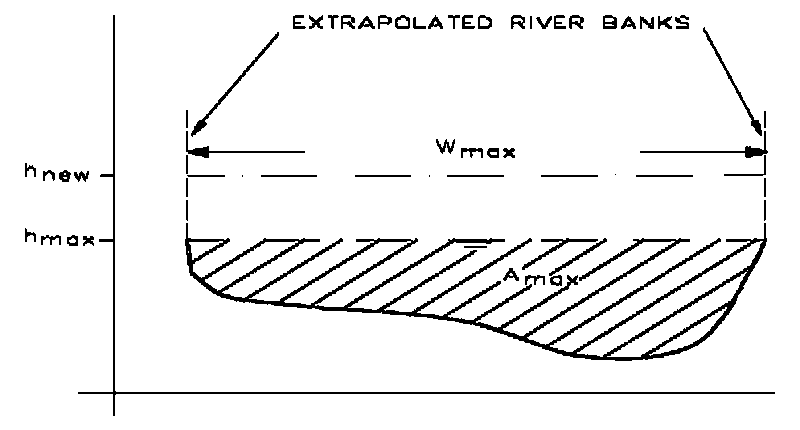
Figure: The vertical wall top slot above maximum specified height. The vertical wall and angled wall top slots should not be used in place of inadequate knowledge about cross section geometry, but only to ensure numerical stability.
When adding top slots for open cross sections, it is strongly recommended that, in defining the cross section geometry, the maximum elevation is specified in such a way that the cross section will accommodate the maximum expected water levels. The top slot is for “emergency” situations only.