Urban-river links
Urban-river links couple collection system and river models.
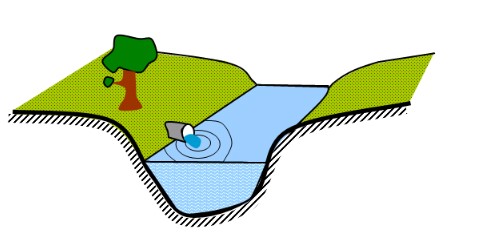
Figure: A collection system outlet discharging to a river. This situation is usually modelled using an urban-river link.
Urban-river links include both two-way and one-way couplings.
In a two-way coupling, the water level boundary in an outlet of a collection system model is coupled to a location in a river model. In the collection system model, the computational coupling node corresponds to an outlet, a weir, or a pump node, while the computational coupling node in the river is an H-point of the river branch. The mechanism is such that the river model delivers a water level to the urban node and in exchange, the urban model sends a discharge to the river model, which is then added as a source point in the corresponding coupling H-point in the river.
The one-way coupling does not have the same feedback mechanism (only possible if the urban node is a weir or a pump), so the urban node must compute the coupling discharge without having the river water level passed back.
The default behavior is the two-way coupling as it is a more realistic approach to simulate two interacting sub-models. Two-way coupling links are recommended for most cases, but one-way coupling links could be used when the hydrodynamics of one of the models is independent of the other; however, this rarely the case.