Garcia & Parker (1991)
Garcia & Parker1 is a true multi-fraction suspended load model. The advection-dispersion equation form used by Garcia & Parker is different from what we normally use in DHI's models:
Equation: Erosion and deposition expressed through the near-bed concentration.
This is reformulated from near bed concentration to depth-integrated concentration by using:
Equation: Relation between near-bed and depth-integrated concentration.
Where \(\gamma\) is the ratio between near bed and depth-integrated concentration, and is calculated from a Rouse profile using \(b = 0.05\), i.e. the 5% of the depth used by Garcia & Parker (1991). This results in a function \(\gamma(Z)\), where \(Z\) is the Rouse number.
Now the source and sink have the generic form:
Equation: Erosion and deposition expressed through the depth-integrated concentration.
Garcia & Parker (1991) provide the entrainment function for sediment mixtures:
Equation: Garcia & Parker entrainment function for sediment mixtures.
Where:
- \(E_{i}\) — entrainment rate for the fraction (\(i\))
- \(Z_{ui}\) — parameter calculated for each fraction (see below)
- \(A\) — constant, \(A = 1.3 \times 10^{-7}\)
- \(F_{i}\) — fraction of (\(i\)) in the surface layer, i.e. surface supply modification
\(E_{i}\) is a volumetric concentration, which can be translated to the internally adopted mass concentration units [g/m3] by multiplying by \(\rho s_{i}\), where:
- \(\rho\) — water density \(\rho = 10^{6}\) g/m3
- \(s_{i}\) — relative sediment density [-] for the considered fraction
The parameter \(Z_{ui}\) is calculated as:
Equation: Parameter Zᵤᵢ in the Garcia & Parker entrainment function.
Where:
- \(u_{f}'\) — skin friction velocity [m/s]
- \(w_{si}\) — settling velocity for the considered fraction [m/s]
- \(\lambda_{m}\) — parameter derived from the geometric grain size distribution [-]
- \(Re_{pi}\) — grain Reynolds number for the fraction
- \(d_{i}\) — grain size for the considered fraction [mm]
- \(d_{50}\) — local median grain size [mm] in the bed surface
The grain Reynolds numbers for the individual fractions are given by:
Equation: Grain Reynolds number for an individual sediment fraction.
The value of \(\lambda_{m}\) is given by Garcia and Parker (1991) as:
Equation: Lambda parameter from the standard deviation of the sediment mixture.
Where \(\sigma_{\phi}\) is the standard deviation of the sediment mixture:
Equation: Standard deviation of the sediment mixture on the phi scale.
Where:
- \(m_{i}\) — mass of each fraction in the bed surface [g/m2]
with the geometric grain sizes \(\phi_{i}\) defined using the phi scale (grain size in [mm]):
Equation: Geometric grain size on the phi scale.
and the mean geometric grain size (i.e. mean phi size) defined as:
Equation: Mean geometric grain size on the phi scale.
Calculation of the γ-function
The derivation of \(\gamma\) is done from the Vanoni concentration profile:
Equation: Vanoni concentration profile.
Where:
- \(c(y)\) — concentration profile
- \(y\) — distance above the bed
- \(h\) — water depth
- \(b\) — reference level where \(b = 0.05h\)
- \(Z\) — Rouse number [-]
The Rouse number is calculated from the total friction velocity \(u_{f}\) to reflect turbulence:
Equation: Rouse number based on the total friction velocity.
The function \(\gamma = c_{b}/C\) is tabulated by numerically integrating the depth-integrated concentration:
Equation: Depth-integrated concentration.
The Vanoni profile now gives a tabulated function:
Equation: The γ-function as the ratio of bed to depth-integrated concentration.
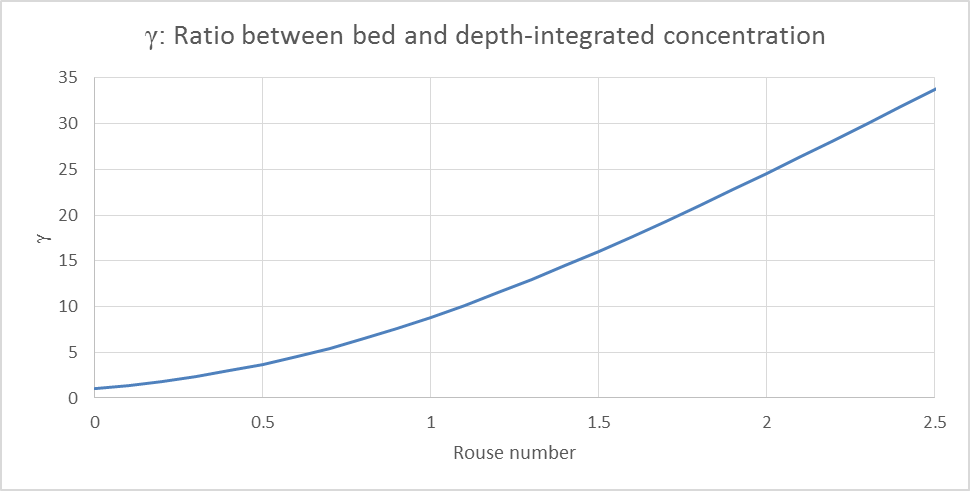
Figure: The γ-function.
The numerically integrated \(\gamma(Z)\) function is shown in the γ-function chart. The parameter is unity for zero Rouse number (i.e. evenly distributed sediment has the same depth-integrated and bed concentrations) and increases quite fast with increasing Rouse number.
Notes regarding Garcia & Parker
Garcia & Parker is a suspended load formula, it does not apply to bed-load.
Garcia & Parker was developed from graded sediment data, and is a true multi-fraction suspended load model.
The model was originally developed for single fraction but was extended to multi-fraction. The single fraction form is imbedded in the presented formulation originally published by the authors.
Garcia & Parker does not use the critical Shields parameter, and therefore does not react to the Ashida & Michiue hiding function, and the formula already includes the surface weight function \(F_{i}\).
-
Garcia, M., and G. Parker (1991) "Entrainment of bed sediment into suspension", Journal of Hydraulic Engineering, 117(4): 414-435. ↩