Weir Formula Structure
The Weir Formula structure models the discharge through a structure with standard weir formulas.
Weir Formula 1
The Weir Formula 1 is based on a standard weir expression simplified according to the Villemonte formula:
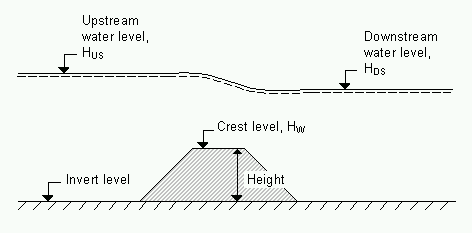
Figure: Definition of terms used in the three Weir Formula structures.
Equation: Discharge through a weir structure with contraction and submergence effects.
Where Q is discharge through the structure, W is width, C is weir coefficient, k is the weir exponential coefficient, Hus is upstream water level, Hds is downstream water level and Hw is weir level. (See the definition of terms used in the three Weir Formula structures).
Weir Formula 2 (Honma)
The Weir Formula 2 is the Honma formula:
Equation: Discharge formula for a broad-crested weir, free-flowing or submerged depending on the downstream/upstream depth ratio.
Where Q is the discharge through structure, W is the width, C1 is the first weir coefficient, \(C_2 = \frac{3}{2} \sqrt{3} C_1\) is the second weir coefficient, Hus is the upstream water level, Hds is the downstream water level and Hw is weir level. (See the definition of terms used in the three Weir Formula structures).
Weir Formula 3 (extended Honma)
The Weir Formula 3 uses the extended Honma formula. The discharge is calculated in three flow regimes: 1) perfect flow, 2) imperfect flow, and 3) submerged overflow. The active regime is defined by the ratio between downstream and upstream water depth above the crest.
Equation: Discharge formula for the weir, with free-flowing, transitional and submerged cases.
where
\(C_{0}~=~{ a}\cdot(h_{u}/H)^{p}+b\)
W is weir width
H is weir height above cross section invert
hd is the upstream water level above the crest
hu is the down stream water level above the crest
(hd/hu)i is a user specified depth ratio limit between perfect and imperfect flow regime.
(hd/hu)s is a user specified depth ratio limit between imperfect and submerged flow regime.
a, b, p, q, r, \(\alpha\) , \(\frac{h}{H}\) , \(\gamma\) , and \(\delta\) are user specified parameters.
NOTE: The MIKE 1D engine does not check if there is a continuous transition from one flow regime to the next. This has to be ensured by the user through proper selection of parameters.