Application of 2D Grid Data
Weather RADAR data in the form of 2D raster grid time series are more and more available for hydrological modelling applications, especially rain data.
Gridded data in the form of dfs2 data is supported for all catchment types. Each catchment requires a set of weights on the form shown in the example of catchment weights below.
Table: Example of catchment weights.
| Catchment | i | j | Weight |
|---|---|---|---|
| A | 2 | 1 | 0.3 |
| A | 2 | 2 | 0.5 |
| A | 3 | 2 | 0.2 |
| B | 3 | 4 | 1 |
The time series value for the catchment is the weighted value, i.e. assuming the grid cell at position (i,j) has the value ri,j then the time series value r will be
Equation: Catchment time-series value calculated as weighted average of grid cell values.
The weights for each catchment must sum to 1.
The user can specify the catchment weights explicitly. If weights are not specified explicitly, the weights will be calculated automatically using the following approach:
- Intersecting area: For small catchments, weights are calculated based on the intersecting area of the polygon and the grid cell. The weight is the fraction of the intersecting area compared to the entire catchment area.
- Grid cell center: For larger catchments, weights are calculated based on whether the center of the grid cell is inside the catchment polygon. Assuming there are nc grid cell centers inside the catchment polygon, the weigth for each grid cell is 1/nc
The approach based on intersecting areas is the most precise, however it is computationally expensive to calculate weights for large catchments and big grids. For performance reasons the approach based on grid cell centers is applied for larger catchment. A catchment is considered "larger" when the area of the catchment is more than 10 times the area of the grid cell, and there are more than 5 grid cell centers inside the catchment polygon.
In the illustration of approach below, for the intersecting area approach, all grid cells with a cross marker will contribute to the weighted value. For the grid cell center approach, only the 10 grid cells with a cross marker inside the catchment polygon will contribute to the weighted valued. This catchment is not considered "larger" because its area is less than 10 times the grid cell area, so the precise intersecting area approach will be used for this catchment.
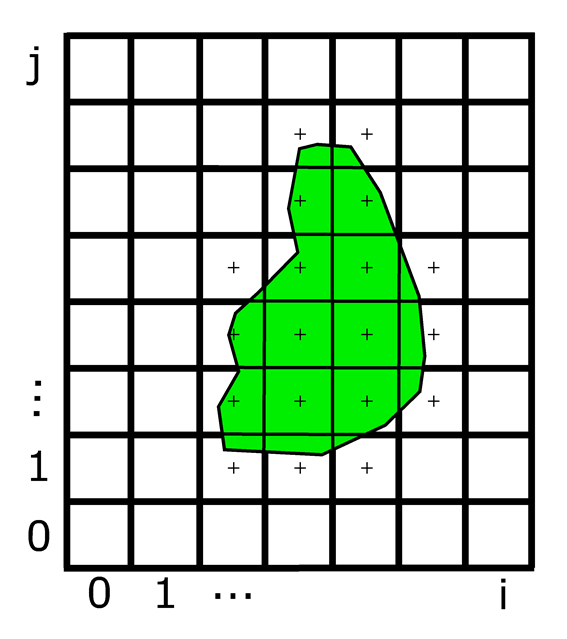
Figure: Illustration of approach.