Low Flow Conditions
During low flow, the cross sections in some reaches may “dry out” (meaning that the water level falls below the reach bottom). Apart from other problems, this gives numerical difficulties which, if no special measures are taken, prohibits a continuation of the computation.
The problem is handled in the 1D engine by the aid of two numerical features:
-
A narrow slot below the cross sections is introduced so that the calculations can continue when the water surface falls below the bottom of the bed, see Section 3.6. If the water level reaches the bottom of the slot, a small amount of water is automatically added to prevent a complete drying out. The applied slot shape starts at a height DELH above the river bottom and extends to 5 x DELH below the river bottom (see the reach cross section with an artificial bottom slot), where DELH is a user specified parameter. The description above DELH over the river bottom is not affected by the slot. Below this point, the calculation of both A, R and b is affected as well as the weighting coefficients in the numerical solution. The computed conditions below this point should thus not be given much weight, but should be seen as a “stand-by” condition until flow starts again.
- The geometry of the slot may be of two types: 1) the width varies as the square root of the depth in the slot or 2) the geometry is so that the cross sectional area is continuous across the local water level DELH. For the latter case the geometry does not introduce an error in the overall water amount as long as the water level does not reach the bottom of the slot. For details on the geometry of the slot please refer to Section A.4.5.2.
-
For low flow conditions the use of the Saint-Venant equation to describe the momentum balance is a unreliable model. This is handled by gradually substituting the momentum equation for low flow condition with a zero flow condition. This weighting is a function of the local water depth and is implemented in such a way that the zero flow condition has full weighting if the water level is less or equal to the local bottom level.
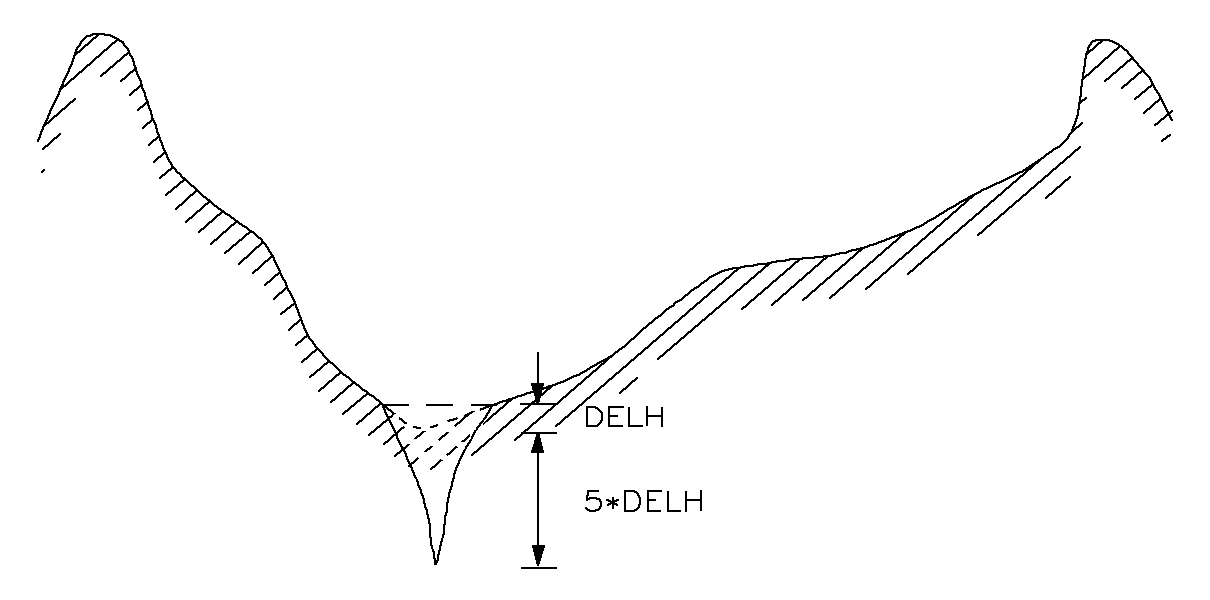
Figure: Reach cross section with an artificial bottom slot.
If one of the two above-mentioned numerical features are active, then the user might be forced to decrease the time step. The gain being the increase in accuracy in the mass balance.