Parker (1990)
The Parker (1990) bed-load formula1 is only appropriate for calculation of bed-load in gravel bed streams.
The non-dimensional bed-load is defined by:
Equation: Definition of the non-dimensional bed-load for a sediment fraction.
In the Parker formula the weight function \(F_{i}\) is renormalized to only include the gravel fractions.
The non-dimensional bed-load is calculated from the formula:
Equation: Parker non-dimensional bed-load.
\(\phi_{i}\) is calculated from:
Equation: Parameter φᵢ in the Parker bed-load formula.
Where \(d_{g}\) is the geometric mean grain size, and \(\phi_{0}\) is calculated from:
Equation: Ratio of the geometric mean Shields parameter to the reference Shields parameter.
Where the skin friction Shields parameter \(\theta_{g}'\) is based on the geometric mean diameter:
Equation: Skin friction Shields parameter for the geometric mean diameter.
And the reference Shields parameter:
Equation: Reference Shields parameter used in the Parker formula.
The G-function is calculated from:
Equation: The G-function in the Parker bed-load formula.
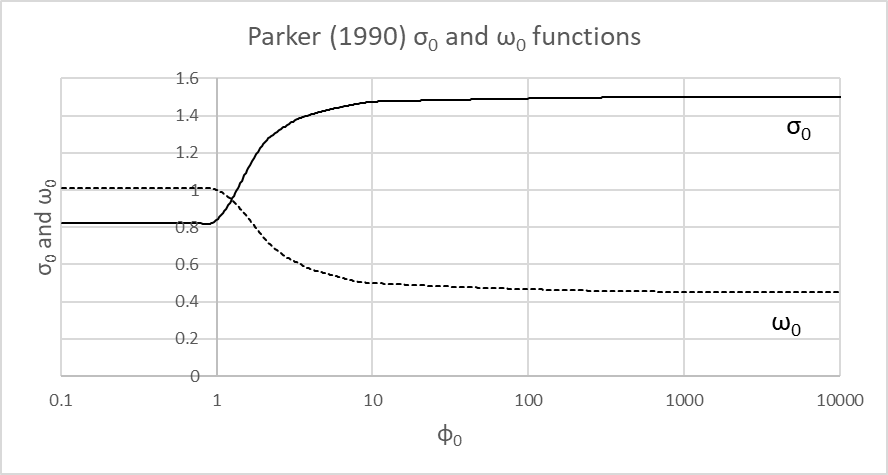
Figure: Parker (1990) σ0 and ω0 functions.
The ω-function is given by:
Equation: The ω-function in the Parker bed-load formula.
Where the two functions \(\sigma_{0}\) and \(\omega_{0}\) are shown in the σ0 and ω0 chart.
Notes regarding Parker
Parker is only selectable for bed-load. The Parker formula was developed for multi-fraction bed-load calculations. The \(F_{i}\) weights are calculated separately and normalized for the gravel fractions.
Parker can be used also for single fraction bed-load.
Egiazaroff does not apply to Parker; it uses its own hiding function.
The GUI critical Shields parameter does not apply.
-
Parker, G. (1990). Surface-based bedload transport relation for gravel rivers, Journal of Hydraulic Research, 28(4): 417-436. ↩