Overview of Network Geometry
The 1D engine simulates water flow on a network. A network consists of
- Reaches
- Nodes
- Grid points
- Digi points
- Cross sections
- Structures
shows an example of a small network with four nodes and three reaches, each having a number of grid points and digi points. Note that the figure does not show the shape of cross sections or structures.
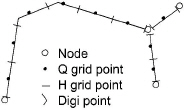
Figure: Example of network.
A cross section is the 2D intersection of a channel (typically a river or a sewage pipe), perpendicular to the channel direction. Among other things, cross sections determine the volume of water in a channel for a given water depth. For a detailed description of the cross sections, see Chapter 3.
A structure is a parameterised model that can calculate a flow over (or through) the structure based on an upstream and downstream water level. Examples are weirs, gates, orifices and pumps. For a detailed description of structures, see Chapter 6.