Flooded Areas and Relative Resistance
Open cross sections can represent as well the main river, as the flooded areas on each side of the main river. If flood areas are represented, then the upper levels of the cross sections are significantly wider than the parts of the cross section representing the main river.
Care is required if the resistance is specified as relative resistances that varies along the cross section profile, and a resistance formulation based on effective area. Then the cross section should be defined such that the water level does not rise above the maximum level of the cross section, i.e. such that the water does not enter the top slot.
The reason is, that he area in the cross section processed data table, and thus used by the engine in the Momentum Equation (4.1b), is the effective area, which is somewhat smaller than the total geometrical area. If water levels rise above the maximum water level in the cross section, properties of the top slot will be used. The top slot calculates width and area based on the geometry of the cross section, and will not take the effect of the varying relative resistance into account: It will assume that the area increases with the geometrical width. This is illustrated in the calculation of cross section area for relative resistance not equal to 1.0. a) Highesta and the calculation of cross section area for relative resistance not equal to 1.0. a) Highestb, which depict the same cross section with a different maximum cross section level hmax. In the calculation of cross section area for relative resistance not equal to 1.0. a) Highesta, hmax is below the highest occurring water level. Then the area added in the top slot part does not account for the relative resistance, giving an incorrect effective area. In the calculation of cross section area for relative resistance not equal to 1.0. a) Highestb, hmax is higher than the highest occurring water level and the effective area is correctly calculated.
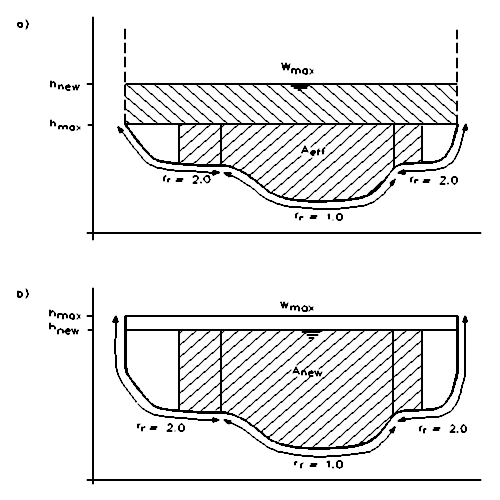
Figure: Calculation of cross section area for relative resistance not equal to 1.0. a) Highest water level above top of cross section, b) highest water level below top of cross section.
Under these circumstances then the top of the cross section (hmax) should be specified to be above the maximum water level encountered in the simulation.