Build-up/Wash-off method
The Build-up/Wash-off method simulates the accumulation of pollutants or sediments on the catchment surface during dry weather and their subsequent wash-off by the mechanical action of rainfall.
Build-up of pollution on the catchment
During dry weather periods, pollution or sediments accumulate on the surface of urban catchments. The most common formulation of this process is to assume that the build-up is a linear or an exponential function of time. The choice between the two formulations is not straightforward, due to insufficient experimental results.
The linear build up function is given as
Equation: Linear build-up of surface pollution below the maximum accumulated mass.
Equation: Linear build-up ceases once the maximum accumulated mass is reached.
and the exponential build-up function is given as
Equation: Exponential build-up of surface pollution, with the maximum accumulated mass given by the ratio of accumulation rate to removal coefficient.
Here:
- \(t\) — time in days
- \(M\) — accumulated mass per area of pollutants at time \(t\), (kg/ha)
- \(M_{\text{max}}\) — maximum accumulated mass per area of pollutants on the catchment, (kg/ha)
- \(A_{c}\) — daily accumulation rate, (kg/ha/day)
- \(D_{\text{rem}}\) — removal coefficient, (1/ha/day)
The coefficient \(D_{\text{rem}}\) represents the removal of pollution from the surface by various mechanisms (for example by wind, traffic, street sweeping, biological and chemical degradation) - all except wash-off. The accumulated mass \(M\) will increase until a limit \(M_{\text{max}} = A_{c}/D_{\text{rem}}\).
The initial value of pollutant mass on catchment surface is determined by building-up mass from 0 for \(\text{ADWP}_{\text{ini}}\) time (duration of antecedent dry weather period before the first event in the simulation).
An example of the two build-up formulations is shown in the build-up function example.
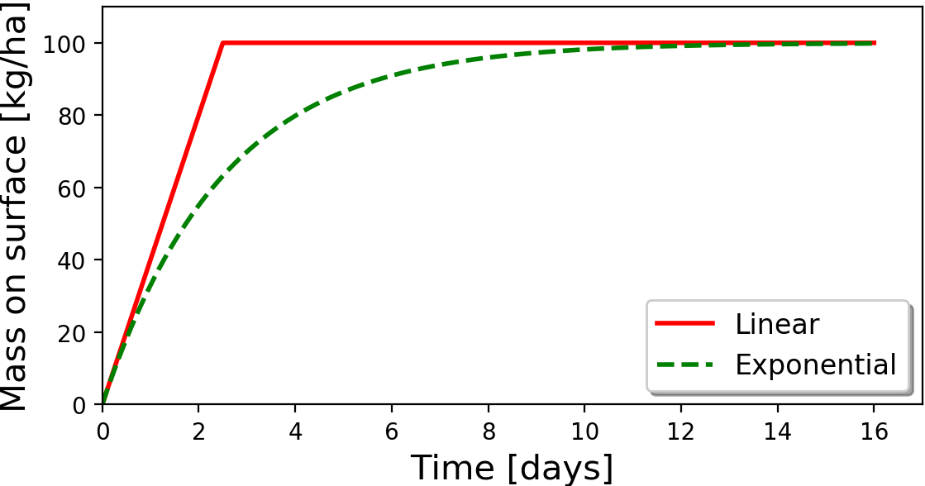
Figure: An example of the linear and the exponential build-up function.
The values of parameters are: \(A_{c} = 40\ \text{kg/ha/day}\), \(M_{\text{max}} = 100\ \text{kg}\), \(\text{ADWP}_{\text{ini}} = 0\ \text{h}\).
When the sediments are being built up in the model, it is possible to attach pollutants to these sediments. The mass of the pollutant \(M_{i,\text{Pollutant}}\) is related to the mass of the sediment \(M_{\text{Sediment}}\) by a simple fraction \(f_{i,\text{PS}}\)
Equation: Pollutant mass attached to sediment, expressed as a fraction of the sediment mass.
The difference between pollutants and sediments from the modelling perspective is that sediments are used as an input to the Sediment Transport (ST) module and pollutants are used as an input to the Advection Dispersion (AD) module.
Wash-off of pollution by rainfall
Wash-off of pollution during a rain event can be divided into two processes: erosion by raindrops and erosion by overland flow. Only the erosion by raindrops is considered in this model. Erosion by raindrops is governed by several parameters. The most important are: rainfall intensity, rainfall depth, rainfall duration, raindrop size, catchment topography, particle characteristics and vegetation. However, parameters such as raindrop size and rainfall depth are rarely available, so a simpler approximation has been adopted in the model. This approximation states that the raindrop erosion is a function of the rain intensity and a detachment rate. The equation for the detachment by rainfall can be written as1:
Equation: Detachment of surface pollution by rainfall as a power function of rain intensity.
where
- \(\text{d}M_{\text{rem}}/\text{d}t\) — pollutant mass washed off by the rain per unit of time, (kg/ha/day)
- \(D_{r}\) — detachment coefficient for rainfall, (kg/ha/day)
- \(i_{r}\) — rainfall intensity, (mm/h)
- \(i_{d}\) — rain intensity constant, (25.4 mm/h)
- \(n\) — exponent (default value 2)
The default value \(n = 2\) assumes that kinetic energy of raindrops is causing the detachment of the pollutant. Kinetic energy is assumed to be quadratically related to rainfall intensity. The rainfall intensity has dimension of velocity, and it is known that kinetic energy \(E\) of water is proportional to square of flow velocity \(v\) (i.e., \(E \propto v^{2}\)).
Only the dissolved pollution is routed together with the runoff. The routing happens based on a catchment model specified. If there are water losses in the catchment model, it is assumed that the pollution is not lost and is extracted back to the catchment surface.
-
Svensson, G., 1987. Modelling of Solids and Metal Transport from small Urban Watersheds. Chalmers University of Technology, Göteborg, Sweden, 1987. ↩