Model structure
Model structure
A conceptual model like NAM is based on physical structures and equations used together with semi-empirical ones. Being a lumped model, NAM treats each catchment as a single unit. The parameters and variables represent, therefore, average values for the entire catchment. As a result some of the model parameters can be evaluated from physical catchment data, but the final parameter estimation must be performed by calibration against time series of hydrological observations.
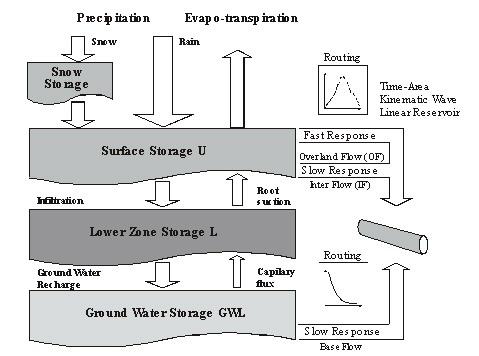
Figure: Model structure of the NAM.
The model structure is shown in the model structure of the NAM. It is an imitation of the land phase of the hydrological cycle. NAM simulates the rainfall-runoff process by continuously accounting for the water content in four different and mutually interrelated storages that represent different physical elements of the catchment. These storages are:
- Snow storage
- Surface storage
- Lower or root zone storage
- Groundwater storage
In addition NAM allows treatment of man-made interventions in the hydrological cycle such as irrigation and groundwater pumping.
Based on the meteorological input data NAM produces catchment runoff as well as information about other elements of the land phase of the hydrological cycle, such as the temporal variation of the evapotranspiration, soil moisture content, groundwater recharge, and groundwater levels. The resulting catchment runoff is split conceptually into overland flow, interflow and baseflow components.
The rainfall passing through the snow storage is controlled by the temperature conditions and the current amount of snow on the catchment surface.
Moisture interception on the vegetation, as well as water trapped in depressions and in the upper-most cultivated part of the ground is represented as surface storage.
Moisture in the root zone, a ground layer below ground surface from where the vegetation can draw water for transpiration, is described as a storage in the lower ground zone, i.e. root zone storage.
The amount of water in the surface storage is continuously diminished by evapo-transpirative consumption set as potential evapo-transpiration, as well as by horizontal leakage (interflow) in the upper ground level. In situations when there is a maximum surface storage achieved, some of the excess water will enter the streams as overland flow, whereas the remainder is diverted as infiltration into the lower zone and further as percolation into the groundwater storage.
Moisture in the lower zone is subject to consumptive loss from evapo-transpiration. This process starts when the surface storage is completely exhausted, and in that situation the actual evaporation depends on the relative contents of the moisture in the lower zone. Additionally, the amount of moisture in the lower zone influences the process of overland flow and amount of water that enters the groundwater storage as recharge.